Before Starting Swimming Pool Construction, Read This
- May 8
- 7 min read
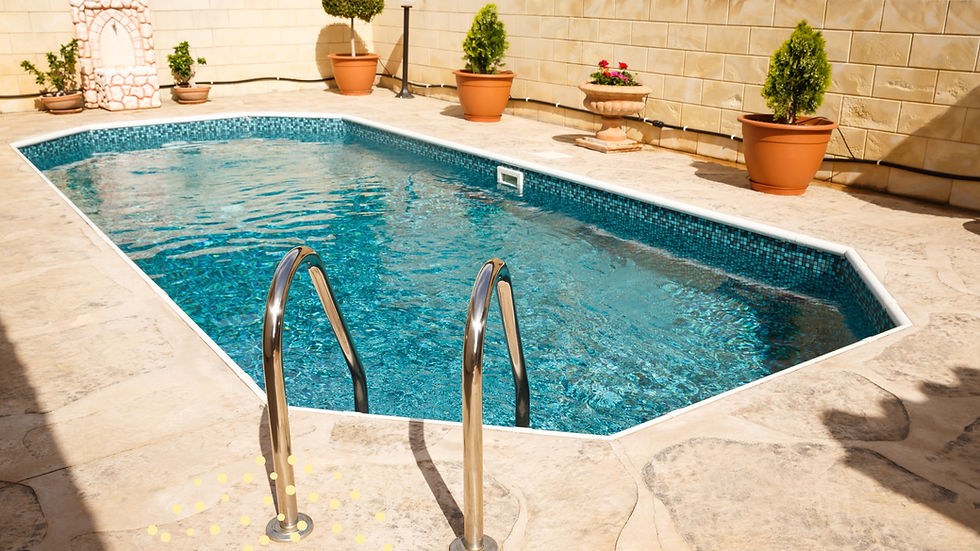
Swimming pool construction is not about tiles, lighting, or visual luxury alone. The distinction is structural, operational, and financial — not aesthetic. Many homeowners, villa developers, hotels, and commercial property investors underestimate how soil conditions, waterproofing systems, filtration engineering, and compliance approvals directly affect long-term maintenance costs and structural reliability.
As a result, poorly planned residential swimming pool construction projects often face leakage, rising electricity consumption, delayed approvals, equipment failure, and expensive reconstruction within a few years. This guide explains what modern swimming pool construction services actually involve, what 2026 market data reveals, and how buyers can evaluate the right swimming pool construction company before investing.
What 2026 Data Reveals About Swimming Pool Construction
According to industry reports from global construction analysts, the luxury outdoor living market is expected to grow by over 8.5% annually through 2028 due to increasing demand for wellness-focused residential spaces. Moreover, resort developers and villa owners are prioritizing custom swimming pool design as a property value multiplier rather than a decorative feature.
Meanwhile, energy audits conducted by commercial hospitality consultants reveal that inefficient pool filtration systems and incorrect hydraulic planning increase annual operating costs by 20–35%. Consequently, property owners who focus only on upfront pricing often pay significantly more over the lifecycle of the pool.
In addition, municipal construction surveys across major Indian metro cities indicate that nearly 40% of pool-related reconstruction issues originate from poor waterproofing systems and improper excavation practices. Therefore, selecting experienced luxury pool contractors has become more important than choosing low-cost vendors.
What does this mean for buyers in 2026? It means swimming pool construction must now be evaluated as a long-term infrastructure investment rather than a short-term design expense.
What Swimming Pool Construction Actually Covers
Phase / Function | What It Specifically Covers |
Site Evaluation | Soil testing, drainage analysis, load assessment |
Pool Excavation and Foundation | Structural digging, reinforcement planning, RCC framework |
RCC Swimming Pool Construction | Concrete shell engineering for long-term durability |
Waterproofing Systems | Chemical coatings, membrane protection, leakage prevention |
Pool Filtration Systems | Pump sizing, filtration efficiency, water circulation |
Custom Swimming Pool Design | Shape planning, depth mapping, luxury features |
Electrical & Lighting Integration | Underwater lights, automation systems, safety compliance |
Infinity Pool Installation | Overflow engineering, edge-level hydraulic balance |
Finishing & Tiling | Anti-slip surfaces, mosaics, coping stone installation |
Swimming Pool Maintenance Cost Planning | Chemical management, cleaning systems, annual cost estimation |
This full-cycle process applies across residential swimming pool construction, hospitality projects, wellness resorts, clubs, and luxury villa developments.
The Gap Nobody Is Talking About
Most buyers believe the biggest risk in swimming pool construction is poor visual finishing. In reality, the biggest financial risk is invisible hydraulic imbalance.
Many contractors install oversized pumps with undersized piping because buyers rarely evaluate hydraulic calculations. Initially, the pool appears functional. However, within 12–18 months, the system begins consuming excessive electricity while creating inconsistent water circulation. Consequently, algae growth, chemical imbalance, and filtration inefficiency become permanent operational problems.
Additionally, many swimming pool construction services outsource waterproofing to third-party vendors with no accountability structure. As a result, cracks and seepage often emerge years after project completion when warranty enforcement becomes difficult.
The implication is simple: long-term performance depends more on engineering coordination than visual presentation.
What Top Property Investors Do Differently
Top developers and premium homeowners approach custom swimming pool design with infrastructure-level planning instead of decorative thinking.
1. They Prioritize Soil Analysis Before Design
Experienced investors conduct soil testing before approving layouts. Therefore, the structural load calculations align with actual ground conditions, reducing future settlement risks.
2. They Evaluate Lifecycle Cost Instead of Initial Cost
Professional buyers compare swimming pool maintenance cost projections before finalizing contractors. As a result, they avoid energy-intensive systems that create high recurring expenses.
3. They Demand Hydraulic Drawings
Leading commercial pool builders provide complete circulation diagrams before execution. Consequently, buyers gain clarity on filtration performance, pump efficiency, and water turnover rates.
4. They Integrate Automation Early
Modern luxury swimming pool construction increasingly includes automated cleaning, lighting, and water balancing systems. Therefore, operational management becomes easier and more cost-effective over time.
5 Key Performance Drivers That Impact ROI
Waterproofing Integrity — prevents structural leakage — poor execution leads to expensive reconstruction.
Hydraulic Efficiency — controls energy usage — poor planning increases electricity bills permanently.
Concrete Quality — ensures shell durability — weak RCC structures develop cracks early.
Filtration Engineering — maintains water quality — improper filtration increases maintenance frequency.
Construction Coordination — reduces project delays — fragmented execution causes cost overruns.
RCC Swimming Pool Construction vs Prefabricated Pools — Decision Matrix
Factor | RCC Swimming Pool Construction | Prefabricated Pools |
Time to Completion | 8–16 weeks | 2–6 weeks |
Upfront Cost | Higher | Lower |
Long-Term Cost | Lower maintenance over lifecycle | Higher repair dependency |
Durability | 25–40 years | 10–15 years |
Design Flexibility | Fully customizable | Limited shapes and sizes |
Structural Reliability | Excellent for large projects | Moderate |
Scalability | Suitable for resorts and villas | Best for compact homes |
Risk Exposure | Lower with proper engineering | Higher panel/joint failure risk |
Best Suited For | Luxury villas, hotels, clubs | Budget residential projects |
Although prefabricated systems offer faster installation, RCC swimming pool construction remains the preferred solution for long-term commercial and luxury residential projects.
Real-World Proof
Case Study 1 — Luxury Villa Project, Goa
A luxury villa developer in Goa planned an infinity pool installation overlooking a coastal property. Initially, the client selected a low-cost contractor without proper soil analysis. Within 14 months, water seepage caused structural cracking and repair costs exceeded ₹18 lakh.
After reconstruction using advanced waterproofing systems and engineered hydraulic planning, operational energy consumption reduced by 28%, while maintenance complaints dropped significantly.
Lesson: Cheap execution often creates premium-level repair costs later.
Case Study 2 — Resort Pool Development, Bengaluru
A hospitality group developing a wellness resort in Bengaluru required commercial swimming pool construction with low operational overhead. The original design included oversized filtration equipment that would have increased annual electricity expenses substantially.
Following hydraulic redesign and optimized pool filtration systems, the project reduced projected operating costs by nearly 31% annually while improving water turnover consistency.
Lesson: Efficient engineering directly impacts long-term business profitability.
How Resgroup Solves This
Resgroup approaches swimming pool construction as a coordinated engineering and execution process rather than a standalone design service. The company combines custom swimming pool design, RCC structural expertise, advanced waterproofing systems, and energy-efficient hydraulic planning under one execution framework. Moreover, Resgroup focuses on scalable solutions for villas, resorts, clubs, and commercial properties while minimizing lifecycle maintenance risks and operational costs.
If you are planning residential swimming pool construction or commercial pool development in 2026, Resgroup can help you evaluate the right engineering approach before construction begins.
Evaluation Checklist
Structural Assessment — Confirm whether soil testing and load analysis are included before excavation.
Hydraulic Drawings — Request circulation and filtration planning documentation.
Waterproofing Warranty — Verify who owns accountability for leakage protection.
Energy Efficiency Planning — Evaluate projected electricity usage for pumps and filtration.
Material Specifications — Check the grade of concrete, piping, and finishing materials.
Maintenance Forecasting — Ask for estimated annual swimming pool maintenance cost projections.
Compliance Documentation — Ensure municipal approvals and safety standards are covered.
Execution Timeline Clarity — Demand milestone-based scheduling before project initiation.
Mistakes to Avoid
Choosing Contractors Based Only on Price
Low-cost vendors often reduce structural quality or hydraulic planning standards. Consequently, operational problems emerge after project completion when repair costs become unavoidable.
Ignoring Waterproofing Specifications
Many buyers focus heavily on tiles and aesthetics while overlooking membrane protection systems. As a result, leakage issues become long-term liabilities.
Skipping Filtration Efficiency Calculations
Improperly sized pool filtration systems increase chemical imbalance and operational expenses. Therefore, hydraulic engineering should always be reviewed before installation.
Overlooking Maintenance Accessibility
Luxury swimming pool construction frequently includes hidden service areas that become difficult to access later. Poor maintenance accessibility increases downtime and repair complexity.
Approving Design Before Soil Evaluation
Pool excavation and foundation planning must align with actual ground conditions. Otherwise, settlement-related cracking becomes a serious structural concern.
Frequently Asked Questions
Q: What should I know before starting swimming pool construction?
A: Before starting swimming pool construction, buyers should evaluate soil conditions, waterproofing methods, filtration engineering, and municipal compliance requirements. Additionally, understanding long-term operating costs is equally important as evaluating initial construction pricing. A professionally planned system reduces maintenance risks and improves durability significantly.
Q: How much does residential swimming pool construction cost in India?
A: Residential swimming pool construction costs vary based on size, depth, materials, hydraulic systems, and luxury features. Basic projects may start around mid-range pricing, while custom swimming pool design with automation and infinity edges can increase investment substantially. Operational efficiency should also be considered while comparing quotations.
Q: How long does RCC swimming pool construction take?
A: Most RCC swimming pool construction projects require 8–16 weeks depending on complexity, weather conditions, and approval timelines. However, larger commercial projects may require longer durations due to structural engineering requirements and finishing details.
Q: Which mistakes should homeowners avoid during pool construction?
A: Homeowners should avoid selecting contractors purely on price, ignoring waterproofing systems, and approving designs without hydraulic review. Moreover, overlooking maintenance accessibility often creates operational difficulties later.
Q: What permits are required for swimming pool construction services?
A: Permit requirements differ based on municipal regulations, project scale, and property classification. In many locations, structural approvals, drainage planning, and electrical safety clearances are required before construction begins. Professional swimming pool construction companies usually assist with compliance coordination.
Conclusion
Swimming pool construction is not a decorative purchase alone — it is a long-term structural and operational investment. Buyers who focus only on visual appeal often underestimate the impact of waterproofing systems, hydraulic efficiency, excavation planning, and lifecycle maintenance costs. Meanwhile, investors and property developers who evaluate engineering quality early typically achieve lower operational expenses, better durability, and higher property value over time.
For official construction and safety standards, refer to the National Building Code of India guidelines.
If you are planning a residential or commercial pool project, Resgroup can help you evaluate the right construction strategy before costly mistakes occur.


Comments