Musical Fountain Design Guide: Costs, Ideas & Mistakes to Avoid in 2026
- Apr 21
- 6 min read
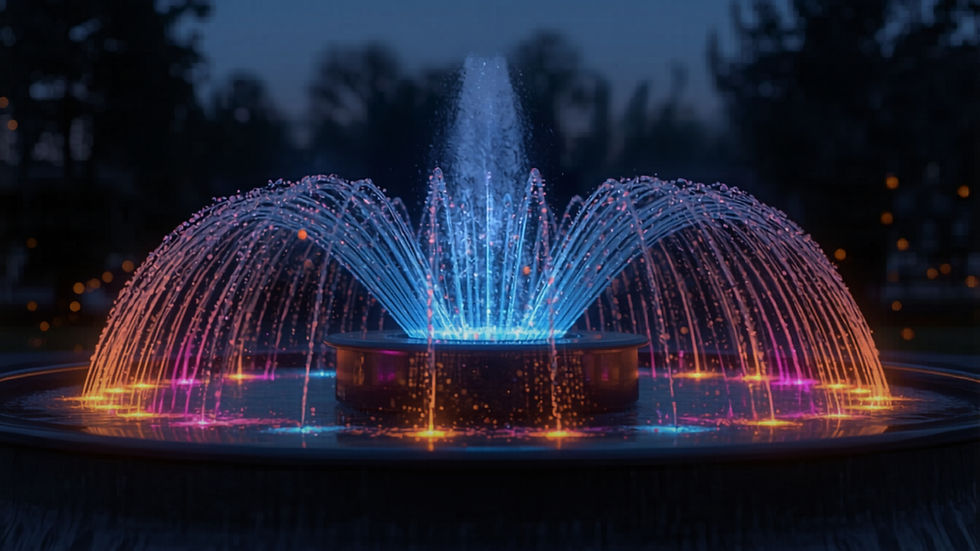
A musical fountain is not a simple water jet with background music. The distinction lies in precise engineering synchronization between water choreography, lighting, and audio — an operational challenge that demands integrated control systems, not decorative add-ons. Developers who treat it as mere landscaping pay dearly through failed shows, soaring maintenance bills, and lost visitor engagement. This guide equips hoteliers, real estate developers, municipal planners, and landscape architects with 2026 data-driven insights, practical design frameworks, cost realities, proven ideas, and critical mistakes to avoid for successful musical fountain projects.
What 2026 Data Reveals About Musical Fountains
The global musical fountain market reached approximately USD 800 million in 2024 and is projected to hit USD 1.5 billion by 2033, growing at a CAGR of 7.5%. This expansion stems from rising demand in commercial and municipal sectors for experiential attractions that drive footfall and tourism revenue.
Music fountain control systems alone are valued at USD 1.34 billion in 2024, expected to reach USD 2.89 billion by 2032 at a 10.2% CAGR. This reflects rapid adoption of advanced synchronization technologies.
Small-to-medium commercial installations typically range from USD 20,000 for basic systems to over USD 100,000–2 million for complex public shows, with installation adding 15% to material costs. Poorly executed projects often see 25–40% higher lifetime costs due to frequent repairs and energy inefficiency.
These figures mean one thing for your decision: Musical fountains have shifted from luxury add-ons to high-ROI assets when designed with precision. Budgeting correctly and choosing the right partner directly determines whether your project becomes a revenue driver or a costly maintenance burden.
What Musical Fountain Design Actually Covers
Phase / Feature | What It Specifically Covers |
Site Assessment & Hydrology | Water source analysis, basin sizing, splash radius calculations, wind and drainage patterns |
Structural Engineering | Pool construction, underwater foundations, load-bearing for nozzles and pumps |
Mechanical Systems | Submersible pumps, musical fountain nozzles, valves, filtration, and recirculation |
Electrical & Controls | Programmable fountain controllers, DMX/PLC integration, weatherproof cabling |
Audio-Visual Synchronization | Fountain music synchronization, LED illuminated musical fountains, laser integration |
Custom Choreography | Custom fountain choreography via software, timing sequences, show scripting |
Lighting & Multimedia | RGB LED systems, underwater fixtures, multimedia water features with projection |
Maintenance & Operations | Energy efficient fountain systems, remote monitoring, seasonal protocols, spare parts inventory |
Permitting & Compliance | Local regulations, water usage permits, electrical safety, accessibility standards |
Testing & Commissioning | Full-show dry runs, synchronization calibration, visitor safety protocols |
The Gap Nobody Is Talking About
Most industry conversations focus on nozzle technology or LED brightness, yet the real failure point lies in control system architecture. Many providers deliver fragmented components that work in isolation but fail to deliver reliable, long-term fountain music synchronization under variable conditions like temperature fluctuations or power surges.
The insight: True durability comes from unified, proprietary control platforms engineered for continuous 10–12 hour daily operation, not retrofitted consumer-grade electronics. Ignoring this leads to shows that degrade within 18–24 months. For decision-makers, this means prioritizing integrated systems over lowest-bid component suppliers to protect your investment.
What Top Developers Do Differently
Invest in simulation-first design — Top teams run full 3D hydrodynamic and synchronization simulations before breaking ground. This cuts physical rework by 40–60% and ensures water patterns match music beats precisely.
Build modular scalability — They start with core zones that expand later, avoiding full system overhauls. This approach supports phased budgets while maintaining show quality.
Integrate predictive maintenance — Sensors and cloud dashboards monitor pump vibration, nozzle pressure, and energy draw in real time, preventing 70% of breakdowns.
5 Key Performance Drivers That Directly Impact ROI
Synchronization Accuracy — Precise timing separates memorable shows from average ones; poor sync reduces visitor dwell time by 30–50% and cuts repeat visits.
Energy Efficiency — Variable frequency drives and optimized nozzles slash power costs by 25–40%; inefficient systems inflate annual OPEX dramatically.
Nozzle & Pump Quality — Premium components resist clogging and wear; cheap alternatives cause uneven patterns and frequent downtime costing thousands in lost revenue.
Control Software Flexibility — Easy reprogramming for seasonal or event-based shows maximizes asset utilization and marketing value.
Water Quality Management — Proper filtration extends equipment life 2–3x; neglect leads to corrosion and blockages that halt operations.
Custom Musical Fountain vs Packaged Systems — Decision Matrix
Criteria | Custom Musical Fountain | Packaged Systems | Best Suited For |
Time to Value | 4–8 months (design + build) | 6–12 weeks | Custom: Signature venues; Packaged: Quick ROI projects |
Upfront Cost | $150,000–$2M+ | $20,000–$250,000 | Depends on scale |
Long-term Cost | Lower (optimized for site) | Higher (frequent upgrades) | Custom for 5+ year horizon |
Durability/Reliability | Superior (site-specific engineering) | Moderate (generic components) | Custom for high-traffic |
Risk Exposure | Lower post-commissioning | Higher (integration failures) | Packaged for low-complexity |
Scalability | Excellent (modular expansion) | Limited | Custom for growing attractions |
Real-World Proof
Case Study 1: Luxury Hotel in Dubai, UAE
A prominent 5-star resort struggled with an outdated fountain that attracted only 200 daily viewers and incurred $18,000 monthly in energy and repairs. After redesigning with advanced LED illuminated musical fountains and AI choreography, nightly audiences grew to over 2,500. Energy costs dropped 38%, delivering payback in 14 months. Lesson: Proper synchronization and efficiency upgrades transform cost centers into crowd magnets.
Case Study 2: Municipal Plaza in Hyderabad, India
The Hussain Sagar area fountain project faced uneven water patterns and frequent breakdowns, limiting shows to weekends. A full system overhaul with programmable controllers and durable nozzles enabled daily multimedia shows. Visitor numbers increased 180%, generating additional tourism revenue estimated at ₹4.5 crore annually. Lesson: Investing in robust mechanical and control systems ensures consistent performance and public value.
How Resgroup Solves This
Resgroup delivers end-to-end musical fountain solutions through proprietary AI-driven choreography software, modular scalable designs that reduce installation costs by up to 30%, and energy-efficient systems backed by comprehensive 5-year warranties. Our approach prioritizes seamless integration across hydrology, controls, and multimedia for reliable, high-impact results tailored to commercial and public environments. Contact our team today to evaluate your site and receive a customized concept plan.
Evaluation Checklist
Site Hydrology Confirmed — Verify water supply pressure, drainage, and splash containment before finalizing layouts.
Control System Unified — Ensure single-platform programming for lights, water, and audio to prevent sync drift.
Energy Modeling Completed — Request projected annual consumption figures based on your operating hours.
Maintenance Access Planned — Confirm easy pump and nozzle access to keep downtime under 2%.
Choreography Flexibility — Verify software allows quick updates for events or seasonal themes.
Warranty & Support — Secure minimum 3–5 year coverage with local service response under 48 hours.
Visitor Safety & Compliance — Check electrical grounding, barriers, and local code adherence.
ROI Projection — Model footfall increase, dwell time, and ancillary revenue potential.
Mistakes to Avoid
Mistake: Underestimating Basin Sizing
Many projects use inadequate catch basins, causing excessive splash and rapid water loss. This burns pumps and creates safety hazards. Always apply the height × 0.75 splash radius formula during planning.
Mistake: Choosing Fragmented Component Suppliers
Sourcing pumps, nozzles, and controllers separately creates integration nightmares. Unified systems from experienced fountain construction specialists prevent compatibility failures and reduce long-term headaches.
Mistake: Ignoring Long-Term Energy and Maintenance
Focusing solely on upfront costs leads to systems with high OPEX. Demand variable speed pumps and smart controls from day one.
Mistake: Poor Nozzle Placement Relative to Wind
Wind disrupts patterns and wastes water. Professional modeling accounts for local microclimates.
Mistake: Skipping Full-Load Commissioning
Rushing handover without extended testing reveals issues only after public opening. Insist on 72-hour continuous operation validation.
Frequently Asked Questions
Q: How much does a musical fountain cost in 2026?
A: Costs vary widely. Small commercial musical fountains start around $20,000–$100,000. Medium to large projects range from $150,000 to several million depending on size, customization, and features like lasers or fire effects. Factor in 15% for installation and budget 8–12% of initial cost annually for maintenance. Always request detailed breakdowns including energy projections.
Q: What are the latest musical fountain design ideas for 2026?
A: Trending concepts include interactive audience-triggered sequences, 3D water curtains with projection mapping, sustainable floating systems for lakes, and eco-friendly low-water designs. Integration with smart city apps for remote show selection is also rising in municipal projects.
Q: How to achieve perfect fountain music synchronization?
A: Use dedicated programmable fountain controllers with DMX or specialized software that analyzes audio in real time. High-end systems employ beat detection and pre-programmed timelines. Professional teams calibrate during commissioning under actual site conditions for reliable results across weather variations.
Q: What are the most common mistakes in musical fountain design and construction?
A: Key errors include inadequate basin sizing leading to splash issues, poor water quality management causing clogs, fragmented control systems, and insufficient maintenance access. Neglecting site-specific wind and hydrology analysis also ranks high among failures.
Q: Which musical fountain system offers the best ROI for luxury venues?
A: Custom-engineered solutions with energy-efficient components and flexible choreography software deliver superior returns. They support multiple daily shows, adapt to events, and minimize downtime — typically achieving payback within 12–24 months through increased visitor spending and brand visibility.
CONCLUSION
A musical fountain succeeds when treated as a precisely engineered, synchronized experience rather than decorative water features. Understanding true costs, embracing proven ideas, and avoiding common pitfalls positions your project for lasting impact and strong financial returns. For authoritative guidance on water features and urban design, explore resources from the U.S. Bureau of Reclamation on water feature engineering.
Ready to create a signature attraction? Connect with Resgroup for expert consultation and turnkey execution.
Written by the Resgroup Strategy Team, led by Arjun Rao (18+ years of experience helping 150+ clients).

Comments